

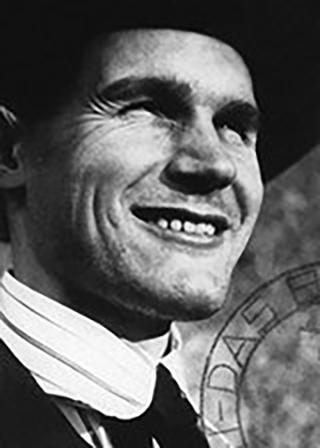
Theo Ballmer (1902–1965)
Raised in Lausanne, Naters, Glis, and Basel, Theo Ballmer attended the Zurich School of Applied Arts after completing an apprenticeship as a lithographer and chemigrapher, where he studied old and new typefaces under Ernst Keller. As in-house graphic designer at Hoffmann-La Roche, he combined photography/photograms, graphics, and typography for the first time in the design of brochures and printed materials. Fascinated by “New Objectivity,” he studied at the Bauhaus Dessau in 1929/1930.
He immersed himself in photography and color theory and completed the constructive font Theo Ballmer (URW++), which is constructed solely from verticals, horizontals, and circles and has no slants. In the 1920s and 1930s, he designed the commercial posters "bureau," "büro,"
"norm" and "Neues Bauen" (New Building) (Collection of the Museum of Modern Art, New York) as well as political posters for the Social Democratic Party, and less frequently for the Communist Party and the Youth Committee Against War and Fascism. He himself was active in the avant-garde movement, drawing particular inspiration from the Constructivists.
Together with architects Ernst Mummenthaler and Otti Meier, he designed the three halls "Gas and Water," "Construction Industry," and "Coop" for the National Exhibition in 1938/1939. From 1930, he was head of the specialist class for typography, graphic design, and photography at the Allgemeine Gewerbeschule Basel, a specialist class for commercial art, where he taught passionately until 1965. In 1983, his wife reported: "Even today, I still meet former students who tell me with awe how Theo's teaching inspired their later work and development."